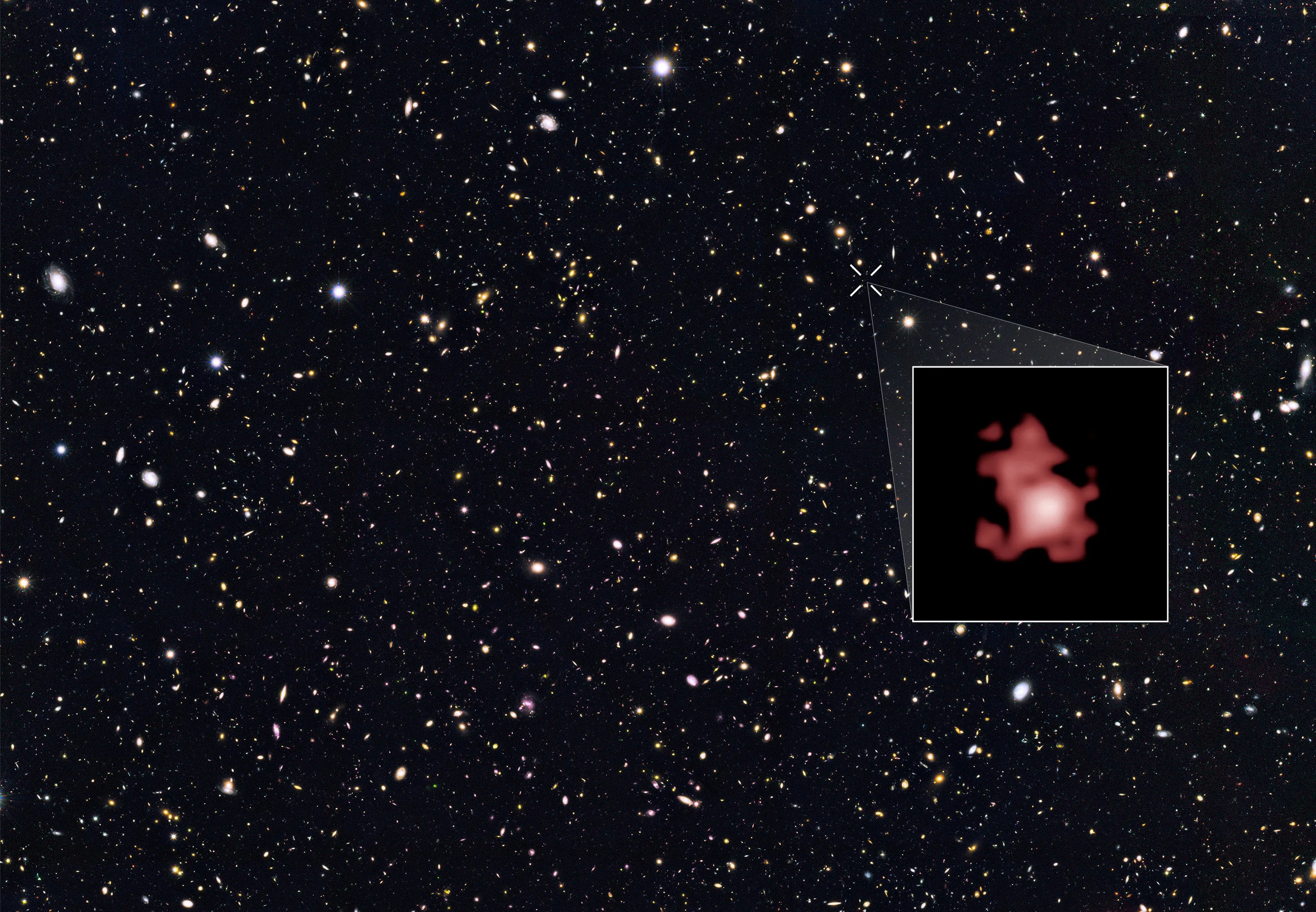
When we look into the night sky, we are not seeing the Universe as it exists at this very moment. Instead, we are witnessing a vast cosmic archive—a collection of ancient messages carried across space by light itself. Every star, nebula, and galaxy visible through a telescope represents a different moment in the history of the Universe.
Astronomers often describe their work as a form of cosmic archaeology. Unlike traditional archaeologists, who uncover artifacts buried beneath layers of earth, scientists studying the cosmos excavate the past by observing light that has traveled across unimaginable distances for millions or even billions of years.
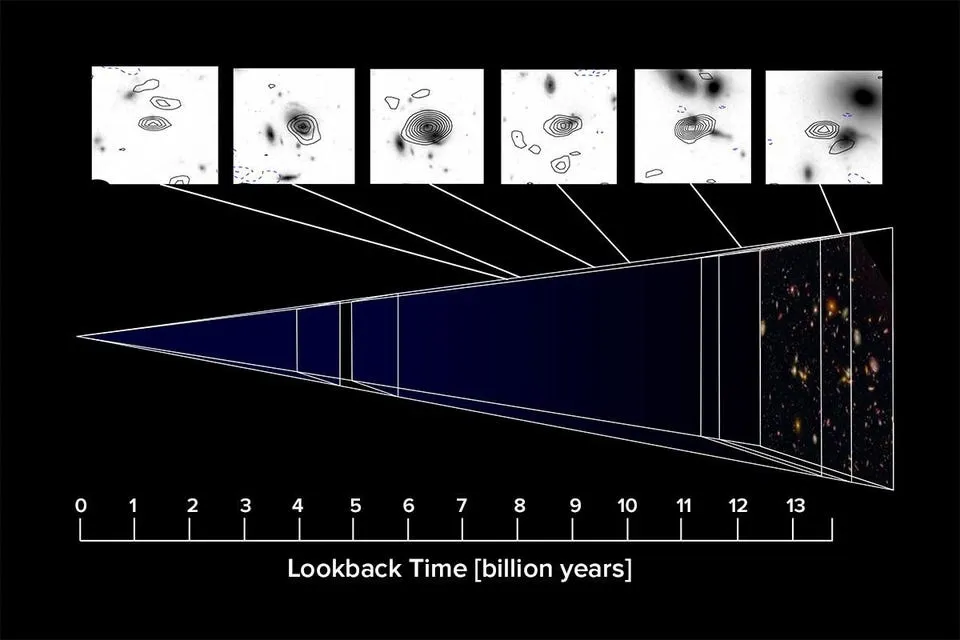
In astronomy, distance and time are inseparable. The farther we look into space, the farther we look back in time. Modern telescopes are, quite literally, time machines that allow humanity to observe the birth of stars, the formation of galaxies, and some of the earliest moments of cosmic history.
Every astronomical image is more than a photograph—it is a glimpse into another era of the Universe.
Light Travels at a Finite Speed
One of the most fundamental principles of physics is that light does not travel instantaneously. In a vacuum, it moves at approximately 299,792 kilometers (186,282 miles) per second—a speed that seems unimaginably fast on human scales.
Yet the Universe is unimaginably large.
Even traveling at light speed, it takes:
- About 1.3 seconds for light to travel from the Moon to Earth.
- Approximately 8 minutes for sunlight to reach our planet.
- More than 4 years for light from the nearest star system, Alpha Centauri, to arrive.
- Around 2.5 million years for light from the Andromeda Galaxy to reach us.
This means that when we observe the Sun, we are seeing it as it appeared eight minutes ago. When we observe Andromeda, we see the galaxy as it existed long before modern humans walked the Earth.
Astronomy is unique among the sciences because observing distant objects automatically means observing the past.
Looking Across Cosmic Time
Imagine receiving a postcard that took one million years to arrive. The message would describe a world that no longer exists in its original form.
Light behaves similarly.
Every photon captured by a telescope carries information about the moment it was emitted. Astronomers are therefore not observing celestial objects in real time—they are studying ancient light that has spent extraordinary amounts of time traveling across the cosmos.
Consider the following examples:
| Object | Distance | Looking Back In Time |
|---|---|---|
| Moon | 1.3 light-seconds | 1.3 seconds |
| Sun | 8 light-minutes | 8 minutes |
| Jupiter | ~43 light-minutes | 43 minutes |
| Andromeda Galaxy | 2.5 million light-years | 2.5 million years |
| Early galaxies observed by modern telescopes | Billions of light-years | Billions of years |
The Universe provides astronomers with a natural timeline stretching across cosmic history.
Why Telescopes Are Time Machines
Unlike fictional time machines, telescopes do not transport us through time. Instead, they collect ancient light that allows us to reconstruct historical events on a cosmic scale.
The larger and more sensitive a telescope becomes, the farther back in time it can observe.
Modern astronomical observatories are designed specifically to answer questions such as:
- How did the first stars form?
- What were the earliest galaxies like?
- How has the Universe evolved over billions of years?
- When did planets begin to appear around other stars?
Every improvement in telescope technology expands our ability to investigate increasingly ancient epochs of cosmic history.
Astronomy is one of the few scientific disciplines where studying the past requires looking outward rather than downward.
Cosmic Redshift: The Universe Is Expanding
One of the most important discoveries in modern cosmology is that the Universe is expanding.
As galaxies move farther away from one another, the light they emit becomes stretched toward longer wavelengths—a phenomenon known as redshift.
Redshift provides astronomers with valuable information about:
- Distance.
- Cosmic age.
- The rate of expansion.
- The evolution of galaxies.
The greater the redshift observed in a distant galaxy, the older the light reaching our telescopes.
This is why astronomers are particularly interested in observing extremely distant galaxies. Their light allows scientists to study periods of cosmic history that occurred shortly after the Universe itself began.
In effect, redshift acts as a cosmic timestamp embedded within the light we observe.
Seeing the Birth of Galaxies
Modern telescopes have dramatically expanded our ability to observe the distant Universe.
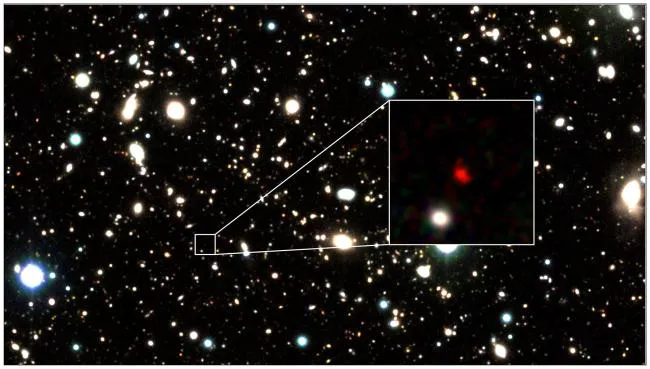
Some galaxies photographed today emitted their light more than 13 billion years ago.
These observations allow astronomers to investigate:
- The formation of the first stars.
- Early galactic structures.
- The distribution of matter in the young Universe.
- The emergence of cosmic complexity.
Studying these ancient objects helps scientists answer fundamental questions about our origins.
How did galaxies evolve?
How did stars enrich the cosmos with the chemical elements necessary for life?
How did the conditions that eventually produced Earth come into existence?
Every distant galaxy represents a chapter in the story of cosmic evolution.
The Cosmic Microwave Background: The Oldest Light in the Universe
If distant galaxies allow us to observe the early Universe, the Cosmic Microwave Background (CMB) enables us to peer even farther back in time.
The CMB is often described as the oldest light humanity can observe.
It originated approximately 380,000 years after the Big Bang—a remarkably brief period in cosmic history.
Before this epoch:
- The Universe was too hot and dense for light to travel freely.
- Matter and radiation existed in a highly energetic state.
- Photons were constantly scattered by charged particles.
As the Universe expanded and cooled, light was finally able to travel across space unimpeded.
Today, astronomers observe this ancient radiation as a faint microwave glow permeating the entire cosmos.
The Cosmic Microwave Background provides scientists with extraordinary insights into:
- The early Universe.
- The distribution of matter.
- Cosmic expansion.
- The fundamental structure of space and time.
It is, in many ways, the oldest photograph ever taken.
Cosmic Photography and Scientific Discovery
Astronomical images are often celebrated for their beauty, but they are also invaluable scientific tools.
Photographs of distant celestial objects help researchers:
- Measure cosmic distances.
- Study stellar evolution.
- Investigate galactic collisions.
- Analyze the composition of interstellar clouds.
- Explore planetary formation.
Every astronomical image preserves information about:
- Time.
- Energy.
- Motion.
- Physical processes.
- Cosmic history.
In astronomy, photography serves both artistic and scientific purposes simultaneously.
The images that inspire public wonder are often the same observations that lead to groundbreaking discoveries.
Why Cosmic Scale Changes Perspective
Understanding that we are constantly observing the past has profound philosophical implications.
The light entering our eyes tonight may have begun its journey:
- Before human civilization existed.
- Before the dinosaurs became extinct.
- Before Earth itself formed.
Astronomy reveals that the Universe operates on timescales vastly different from those of human experience.
This perspective encourages humility and curiosity.
We are part of a cosmic story billions of years in the making—a story recorded not in books or monuments, but in the light traveling silently through space.
The Future of Cosmic Archaeology
The next generation of telescopes promises to deepen our understanding of cosmic history even further.
Future observatories will allow scientists to:
- Detect fainter and more distant galaxies.
- Study the atmospheres of exoplanets.
- Investigate the formation of the first stars.
- Map large-scale cosmic structures with unprecedented precision.
As our instruments become increasingly sophisticated, humanity’s ability to reconstruct the history of the Universe will continue to grow.
The deeper we look into space, the further back we travel through time.
Conclusion
Astronomy teaches us that light is far more than illumination—it is a messenger from the distant past. Every star we observe and every galaxy captured by a telescope offers a glimpse into another moment in cosmic history. By studying ancient photons that have traveled across billions of light-years, astronomers are piecing together the story of how the Universe evolved from its earliest beginnings to the magnificent cosmic landscape we inhabit today.
The archaeology of light reminds us that the night sky is not merely a collection of distant objects. It is an archive of time itself. Every astronomical image is a historical document written in starlight, waiting to be read by those curious enough to look beyond the present and into the deep history of the cosmos.
FAQ
Why do astronomers say we are looking into the past?
Because light takes time to travel across space. The farther away an object is, the older the light we receive from it.
How far back in time can telescopes see?
Modern telescopes can observe galaxies whose light has traveled for more than 13 billion years, allowing scientists to study the early Universe.
What is a light-year?
A light-year is the distance that light travels in one year—approximately 9.46 trillion kilometers (5.88 trillion miles).
What is the Cosmic Microwave Background?
It is the oldest observable light in the Universe, originating about 380,000 years after the Big Bang.
Are telescopes really time machines?
In a scientific sense, yes. Telescopes allow us to observe ancient light and study events that occurred millions or billions of years ago.