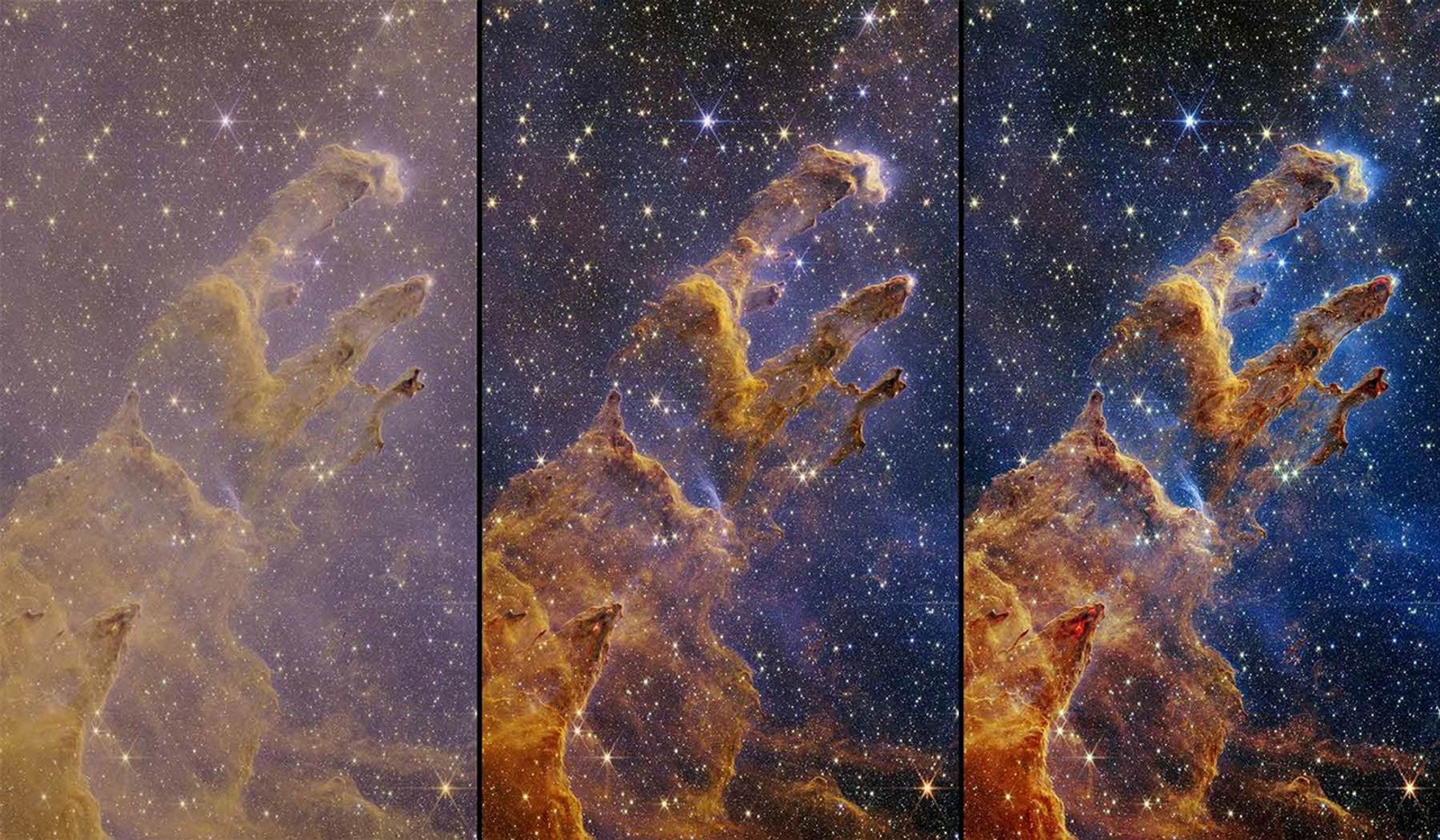
When the James Webb Space Telescope released its first full-color images in July 2022, millions of people around the world were captivated by their breathtaking beauty. Swirling nebulae painted in gold and turquoise, galaxies shimmering in crimson and sapphire, and cosmic landscapes that seemed more like works of art than scientific data instantly became cultural icons. Yet one question continues to appear beneath almost every astronomical image: Are these colors real?
The answer is both simple and fascinating. Space telescopes do not take photographs the way smartphones or digital cameras do. They collect scientific data—streams of light captured across different wavelengths—and scientists carefully transform that information into the images we admire. Every color, every detail, and every glowing structure is the result of a deliberate process designed to reveal the hidden nature of the Universe.
Behind every pixel lies not only science but also a story billions of years in the making.
Space Telescopes Don’t Take Color Photographs
Contrary to popular belief, telescopes such as Hubble or James Webb do not simply point at an object and capture a colorful image in a single exposure.
Astronomical instruments record light as grayscale data. Each observation measures the intensity of light passing through a specific filter or wavelength range. In other words, every image initially appears as a black-and-white photograph.
Imagine photographing a flower using separate red, green, and blue filters. Each image would reveal different details and brightness levels. When combined, these monochrome images create a full-color representation. Space telescopes operate on the same principle—only their filters often extend far beyond human vision.
The Universe emits radiation across the entire electromagnetic spectrum, including:
- Visible light
- Infrared radiation
- Ultraviolet light
- X-rays
- Radio waves
- Gamma rays
Human eyes perceive only a tiny fraction of this cosmic information. Space telescopes allow us to observe the invisible.
From Raw Data to Scientific Images
The journey from telescope data to a published astronomical image involves several stages.
Step 1: Collecting Light
Astronomical observations can last from several minutes to dozens of hours. During this time, a telescope collects photons arriving from distant cosmic objects.
Scientists may capture:
- One exposure through an infrared filter
- Another through a near-infrared filter
- Additional exposures highlighting specific chemical elements
- Deep observations revealing faint structures
Every exposure is stored as scientific data rather than a traditional photograph.
Step 2: Calibration
Raw observations contain imperfections caused by:
- Electronic noise
- Cosmic rays striking detectors
- Sensor artifacts
- Thermal effects
- Optical distortions
Astronomers use calibration techniques to remove unwanted signals and improve data quality. Specialized software corrects defects and aligns multiple observations with extraordinary precision.
Without calibration, some of the most famous images of space would appear blurry or filled with noise.
Step 3: Combining Multiple Images
Once calibrated, scientists align the images captured through different filters.
A single published image may combine:
- Three filters
- Five filters
- Ten filters
- More than twenty separate observations
The result is a multidimensional dataset representing physical properties of celestial objects.
This stage is where scientific visualization truly begins.
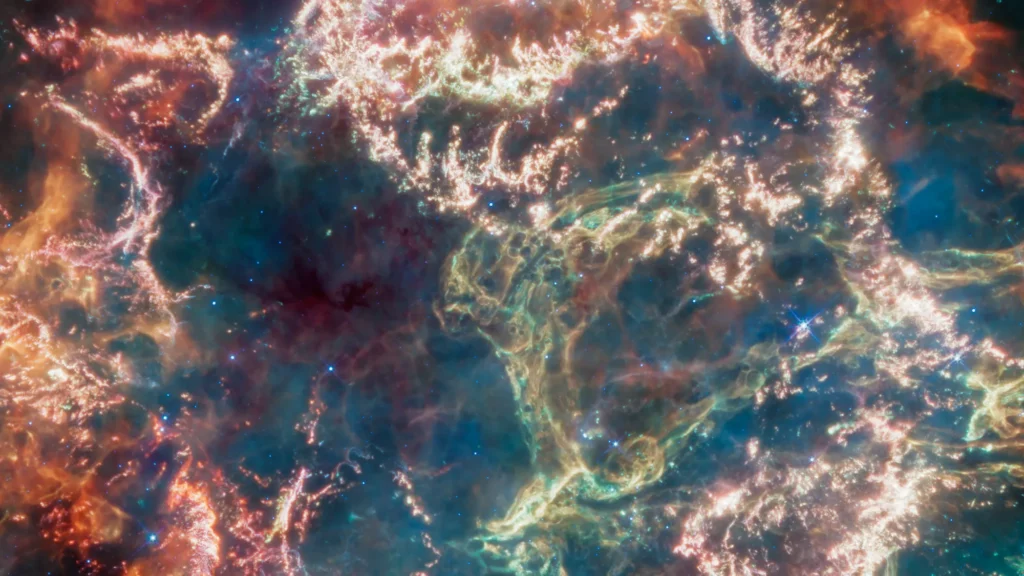
Why Are Space Images Often Called “False Color”?
The phrase false color is frequently misunderstood. It does not mean that astronomical images are fake.
Instead, it means that colors are assigned to data outside the visible spectrum so humans can interpret the information.
Consider the James Webb Space Telescope. Webb primarily observes infrared light, which is completely invisible to the human eye.
If scientists displayed Webb’s raw observations directly, we would see nothing.
To visualize the data, astronomers assign colors according to wavelength:
- Shorter infrared wavelengths are often represented in blue.
- Intermediate wavelengths may appear green or yellow.
- Longer wavelengths are commonly displayed in orange or red.
These color choices preserve scientific relationships while making invisible information accessible.
The resulting images are scientifically accurate visual translations rather than artistic inventions.
Why Colors Matter in Astronomy
Colors in astronomical imagery are more than aesthetic choices. They communicate scientific information.
Different wavelengths reveal different physical phenomena:
Blue Regions
Often indicate:
- Higher-energy radiation
- Hot gas
- Young stars
- Scattered light
Red Regions
Frequently represent:
- Cooler material
- Dust clouds
- Longer infrared wavelengths
- Star-forming regions
Green and Gold Structures
May highlight:
- Molecular clouds
- Chemical compositions
- Intermediate temperatures
- Specific emission lines
Scientists carefully select color palettes that help distinguish structures invisible in monochrome data.
A color image allows researchers—and the public—to identify relationships that might otherwise remain hidden.
The Hubble Space Telescope’s Color Philosophy
The Hubble Space Telescope transformed scientific imaging into a form of visual storytelling.
Many of its most iconic photographs use three categories of filters:
- Blue
- Green
- Red
However, Hubble also employs narrowband filters that isolate light emitted by specific elements.
Examples include:
- Hydrogen
- Oxygen
- Sulfur
One famous technique is known as the SHO palette:
| Element | Assigned Color |
|---|---|
| Sulfur | Red |
| Hydrogen | Green |
| Oxygen | Blue |
This method reveals the chemical structure of nebulae with remarkable clarity.
The resulting colors are not necessarily what astronauts would see if standing nearby. Instead, they provide a scientifically meaningful map of cosmic composition.
How James Webb Reveals the Invisible Universe
The James Webb Space Telescope operates primarily in infrared wavelengths.
Infrared astronomy offers several unique advantages:
Seeing Through Cosmic Dust
Many stellar nurseries are hidden behind thick clouds of dust.
Visible light is scattered or absorbed by these particles, but infrared radiation can penetrate them, allowing scientists to observe:
- Newly forming stars
- Protoplanetary disks
- Hidden galactic structures
Observing Ancient Galaxies
Because the Universe is expanding, light from distant galaxies becomes stretched toward longer wavelengths—a phenomenon known as redshift.
Infrared observations enable astronomers to study:
- The earliest galaxies
- Cosmic evolution
- The first generations of stars
Without infrared imaging, much of the distant Universe would remain inaccessible.
Scientific Visualization Is Both Science and Art
Producing an astronomical image requires more than technical expertise.
Image specialists must make decisions about:
- Color assignments
- Brightness levels
- Contrast adjustments
- Noise reduction
- Cropping and composition
These choices resemble artistic processes, yet every adjustment must preserve scientific integrity.
Astronomers often describe their work as scientific visualization rather than photography.
The goal is to answer questions such as:
- What structures are scientifically important?
- How can hidden details be revealed?
- Which colors best communicate physical information?
- How can the image remain accurate while being understandable?
The most successful astronomical images are those that educate and inspire simultaneously.
Why Astronomical Images Are Not “Photoshopped”
A common misconception is that space images are heavily manipulated or digitally fabricated.
In reality, scientific image processing is comparable to techniques used in many other scientific fields, including:
- Medical imaging
- Climate science
- Microscopy
- Satellite observations
Raw data from telescopes are simply not designed for human perception.
Processing helps transform measurements into meaningful visual information.
Scientists do not invent stars or galaxies that do not exist. Instead, they reveal features hidden within enormous datasets collected by sophisticated instruments.
Every published image is based on actual observations.
Beauty Has Scientific Value
Astronomical imagery serves an important scientific purpose beyond public outreach.
Beautiful images can:
- Improve scientific interpretation
- Highlight subtle structures
- Support educational initiatives
- Inspire future researchers
- Communicate complex discoveries to non-specialists
Images from space have motivated generations of astronomers, engineers, artists, and educators.
Projects that combine science and visualization remind us that discovery is not limited to equations and datasets—it is also an experience of wonder.
Conclusion
The spectacular images released by modern space telescopes are far more than digital artwork. They are carefully crafted scientific visualizations built from raw measurements of the Universe itself. Every color assignment, every filter, and every pixel carries valuable information about the physical processes shaping galaxies, stars, and nebulae across billions of light-years.
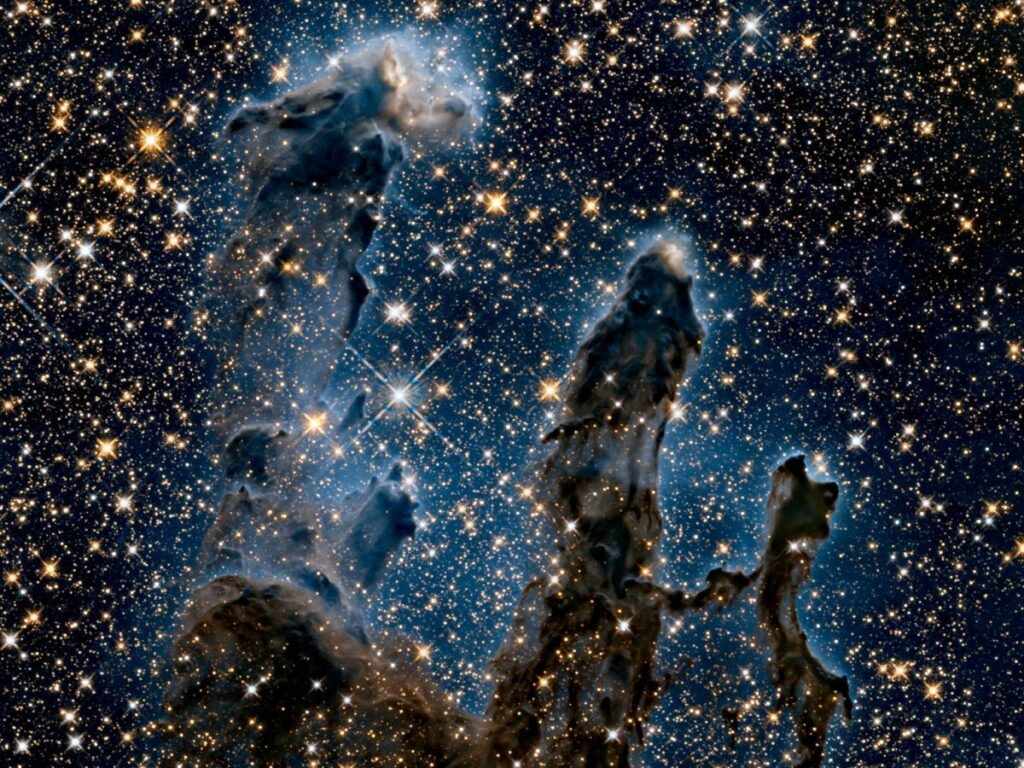
When we admire the glowing pillars of cosmic dust or the shimmering arcs of distant galaxies, we are not looking at imaginary worlds. We are witnessing humanity’s best attempt to translate invisible cosmic signals into something our eyes and minds can understand.
Behind every pixel lies light that may have traveled for millions—or even billions—of years before reaching our telescopes. Through science, technology, and creativity, we transform that ancient light into images that allow us to see our place within the vast and beautiful Universe.
FAQ
Are the colors in NASA space images real?
They are scientifically accurate representations of real data. Colors are often assigned to different wavelengths of light, especially those invisible to human eyes.
Why are telescope images initially black and white?
Astronomical detectors record light intensity through individual filters, producing monochrome images that are later combined during processing.
What does “false color” mean?
False color refers to assigning visible colors to non-visible wavelengths such as infrared or X-rays so humans can interpret scientific information.
Can the human eye see what the James Webb Space Telescope sees?
No. Webb observes infrared light, which is invisible to humans. Its images are visual translations of scientific measurements.
Why do scientists spend so much time processing astronomical images?
Image processing removes noise, combines multiple observations, and highlights important physical structures while preserving scientific accuracy.