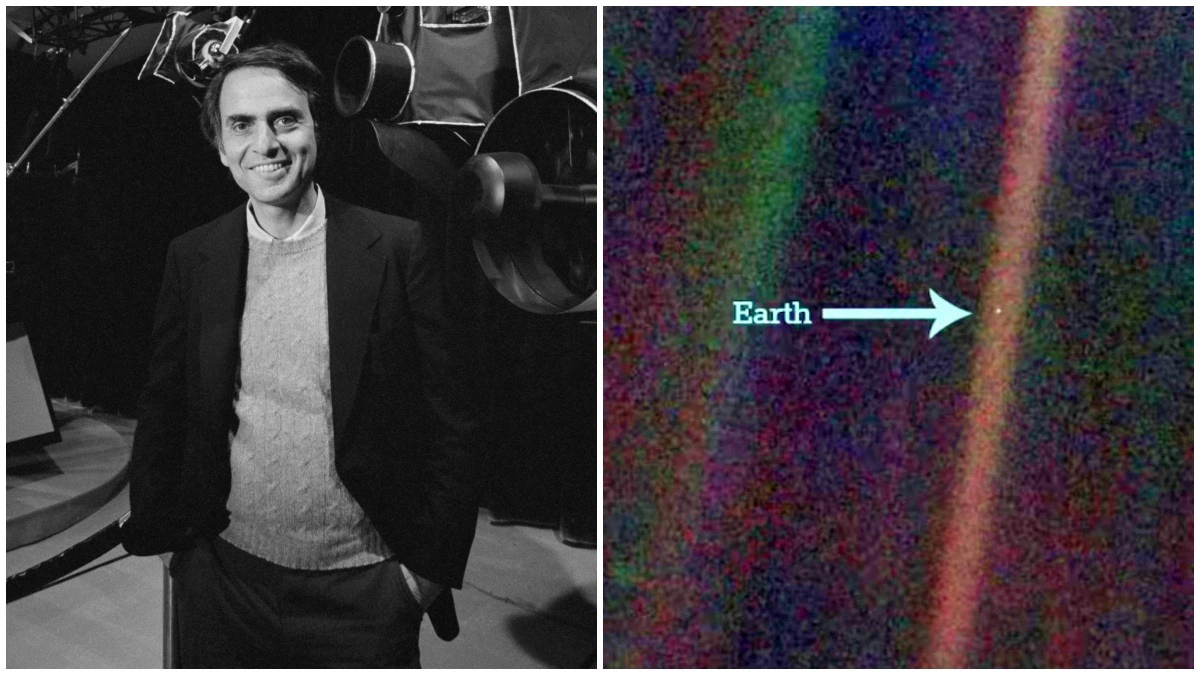
On February 14, 1990, a spacecraft nearly four billion miles from home turned its camera back toward the Solar System for one final farewell. Suspended within a scattered beam of sunlight was an almost imperceptible speck—a tiny, pale blue point of light that represented everything humanity had ever known.
That speck was Earth.
The image, captured by Voyager 1 at the request of astronomer and science communicator Carl Sagan, would become one of the most influential photographs in human history. Unlike the dramatic images of distant galaxies or colorful nebulae that dominate modern astronomy, the photograph contains almost nothing. There are no continents, no oceans, and no visible signs of civilization. Earth occupies less than a single pixel in the image.
And yet, few scientific images have had such profound philosophical and cultural consequences.
The Pale Blue Dot transformed the way we think about our planet—not as the center of the Universe, but as a fragile world suspended in a vast cosmic ocean. It challenged our understanding of human significance while simultaneously reminding us that everything we love, build, and protect exists on this tiny point of light.
More than three decades later, the image continues to shape conversations about environmental responsibility, scientific curiosity, and humanity’s place in the cosmos.
A Photograph Almost Never Taken
The Pale Blue Dot image owes its existence largely to Carl Sagan’s persistence.
By 1990, Voyager 1 had completed its primary mission of exploring the outer planets and was traveling toward interstellar space. Sagan proposed an unusual idea: before permanently shutting down its cameras, the spacecraft should turn around and photograph the Solar System from the greatest distance ever attempted.
The proposal initially faced opposition. Engineers worried about pointing the spacecraft’s sensitive instruments toward the Sun, while some questioned the scientific value of such an image.
Eventually, the request was approved.
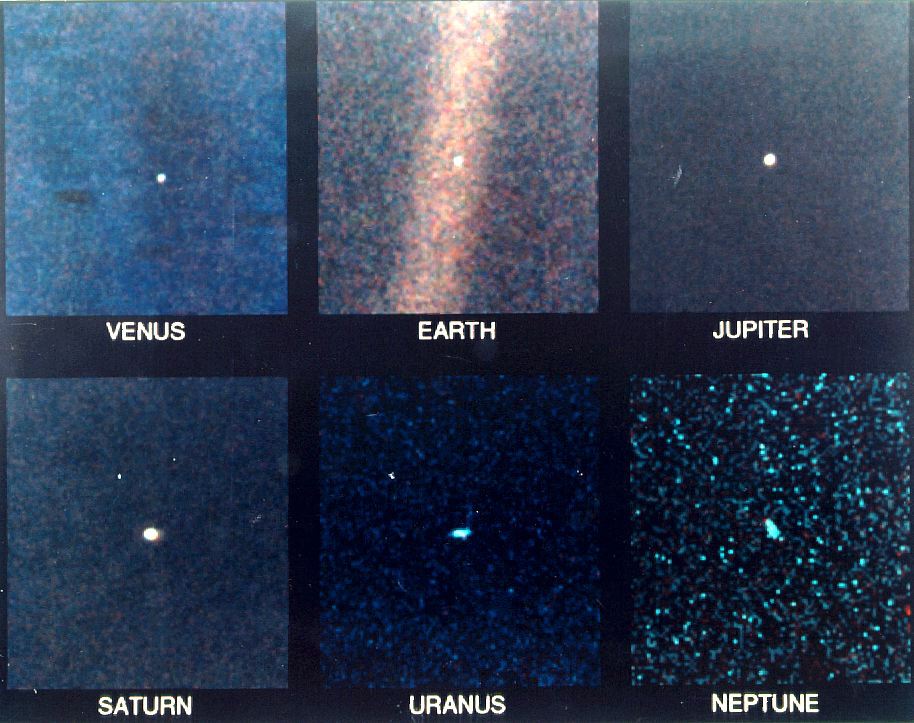
Voyager 1 captured a series of photographs known as the “Family Portrait” of the Solar System, including images of:
- Venus
- Earth
- Jupiter
- Saturn
- Uranus
- Neptune
Mercury and Mars could not be photographed because of their proximity to the Sun.
Among all these planetary portraits, it was Earth’s image that would become iconic.

Earth as a Single Pixel
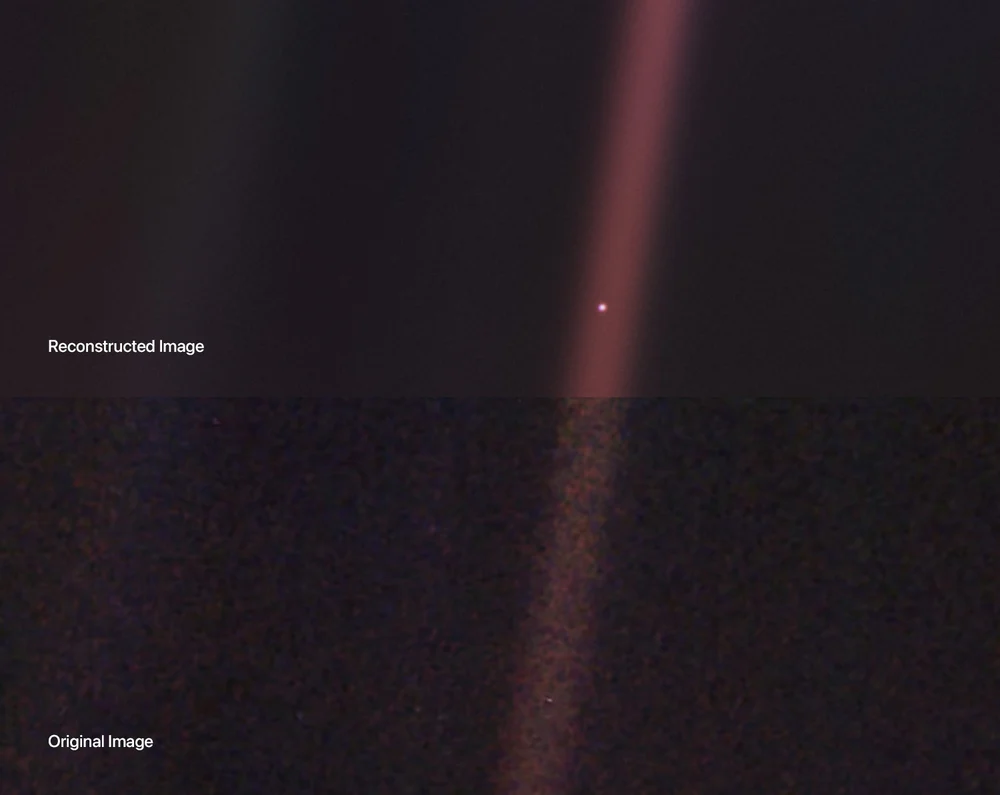
The famous photograph reveals Earth as a tiny blue-white speck embedded within a ray of scattered sunlight.
From Voyager 1’s perspective:
- Earth occupied less than one pixel.
- The spacecraft was approximately 3.7 billion miles (6 billion kilometers) from our planet.
- The image required sophisticated processing to identify Earth’s location.
Without knowing where to look, many viewers would never recognize the planet at all.
This realization carries enormous philosophical weight.
Everything humanity has ever experienced exists within that single pixel:
- Every civilization.
- Every scientific discovery.
- Every work of art.
- Every conflict and triumph.
- Every human being who has ever lived.
The photograph reduces human history to a point of light suspended in cosmic darkness.
Carl Sagan’s Timeless Reflection
The image became inseparable from Carl Sagan’s celebrated reflection in his 1994 book Pale Blue Dot.
He wrote:
“Look again at that dot. That’s here. That’s home. That’s us.”
Sagan’s essay remains one of the most powerful pieces of scientific writing ever produced. He reminded readers that every emperor, philosopher, explorer, artist, and child in human history lived their entire lives upon this tiny world.
He continued by observing that our imagined importance is challenged by the overwhelming scale of the cosmos. There is no visible indication in the photograph that help will come from elsewhere to save us from ourselves.
The Pale Blue Dot is therefore not a message of human insignificance, but rather one of shared responsibility.
If Earth is our only home, then caring for it becomes a profoundly cosmic obligation.
The Birth of a Cosmic Perspective
Astronomy has repeatedly changed humanity’s understanding of its place in the Universe.
Throughout history, scientific discoveries have shown us that:
- Earth is not the center of the Solar System.
- The Sun is one star among billions in the Milky Way.
- The Milky Way is one galaxy among hundreds of billions in the observable Universe.
The Pale Blue Dot distilled centuries of scientific progress into a single image.
For perhaps the first time, humanity saw itself from a truly cosmic perspective.
The photograph encourages an important question:
What differences between nations, cultures, and ideologies remain significant when viewed from billions of miles away?
The answer, many argue, is remarkably few.
Environmental Awareness and the Pale Blue Dot Effect
Although the image was not created as an environmental campaign, it has become one of the most influential symbols of planetary stewardship.
Environmental educators frequently use the Pale Blue Dot to illustrate:
- Earth’s fragility.
- The uniqueness of our biosphere.
- The interconnectedness of human societies.
- The importance of sustainability.
- The limitations of planetary resources.
Unlike other planets in our Solar System, Earth possesses:
- Liquid water on its surface.
- A breathable atmosphere.
- Extraordinary biodiversity.
- Conditions capable of supporting complex life.
From a cosmic perspective, our planet appears astonishingly rare and precious.
The Pale Blue Dot encourages us to think beyond political borders and recognize that environmental challenges affect the only known world capable of sustaining human civilization.
Why Astronomy Can Inspire Empathy
One of astronomy’s most remarkable qualities is its ability to inspire humility.
When we observe distant galaxies billions of light-years away, human concerns may appear small in comparison. Yet astronomy often produces the opposite emotional effect—it strengthens our appreciation for life on Earth.
Studies in science communication have suggested that exposure to cosmic imagery can encourage feelings of:
- Awe
- Curiosity
- Connectedness
- Environmental concern
- Global identity
The Pale Blue Dot embodies all of these responses.
By confronting us with our apparent smallness, the image simultaneously emphasizes the immense value of our shared existence.
Humanity may occupy only a tiny corner of the Universe, but it is our corner—and, so far, the only one we know.
The Photograph That Changed Science Communication
Few scientific images have achieved the cultural influence of the Pale Blue Dot.
Its impact extends across:
- Astronomy
- Environmental education
- Philosophy
- Literature
- Public policy discussions
- Science communication
The image has inspired:
- Books
- Documentaries
- Educational programs
- Public lectures
- Space exploration initiatives
Scientists frequently cite the Pale Blue Dot as one of the most effective examples of how visual science communication can influence public understanding.
Its power lies not in technical complexity but in emotional resonance.
Sometimes, a scientific image changes the world not by showing us something spectacular, but by helping us see something familiar in an entirely new way.
The Pale Blue Dot in the Modern Space Age
Today, humanity possesses more advanced telescopes and spacecraft than Carl Sagan could have imagined when Voyager 1 captured its historic image.
Modern astronomy routinely produces breathtaking observations of:
- Distant galaxies.
- Exoplanets.
- Stellar nurseries.
- Black holes.
- Cosmic structures spanning millions of light-years.
Yet the Pale Blue Dot remains uniquely powerful.
Unlike most astronomical images, it does not invite us to marvel at distant wonders. Instead, it asks us to look back at ourselves.
As humanity prepares for future missions to the Moon, Mars, and beyond, the photograph continues to offer an important reminder: wherever we travel, Earth will remain the birthplace of our civilization.
Lessons for the Future
The Pale Blue Dot teaches several timeless lessons:
- Scientific exploration can deepen our humanity.
- Perspective matters.
- Environmental responsibility is inseparable from planetary citizenship.
- The cosmos is vast, but our home is small and precious.
- Wonder and humility are not opposites—they are partners in scientific discovery.
Perhaps Carl Sagan expressed it best when he suggested that astronomy is a humbling and character-building experience.
The Pale Blue Dot remains one of humanity’s greatest exercises in humility.
Conclusion
The Pale Blue Dot is more than a photograph—it is a philosophical mirror held up to humanity. Captured from the edge of the Solar System, it reminds us that every human story, every achievement, and every hope for the future exists on a tiny world adrift in an immense Universe.
Its enduring influence lies in its extraordinary simplicity. By reducing our entire planet to a nearly invisible speck of light, the image reveals something profound: our apparent smallness does not diminish our significance. Instead, it underscores the importance of protecting the fragile world we all share.
More than thirty years after Voyager 1 looked back toward home, the Pale Blue Dot continues to inspire scientific curiosity, environmental awareness, and a deeper appreciation for our place among the stars. In the end, perhaps its greatest lesson is also its simplest—this tiny blue dot is all we have ever known, and it is worth caring for.
FAQ
What is the Pale Blue Dot?
The Pale Blue Dot is a photograph of Earth taken by Voyager 1 in 1990 from approximately 3.7 billion miles away, showing our planet as a tiny speck of light.
Why is the image historically important?
It fundamentally changed public perspectives on Earth’s place in the Universe and inspired discussions about environmental responsibility and human unity.
Who proposed taking the photograph?
Astronomer and science communicator Carl Sagan strongly advocated for capturing the image before Voyager 1 permanently shut down its cameras.
What message did Carl Sagan associate with the Pale Blue Dot?
Sagan used the image to emphasize humanity’s shared existence, the fragility of Earth, and our responsibility to care for our only known home.
How does the Pale Blue Dot influence science education today?
The photograph is widely used in astronomy, environmental studies, and philosophy to teach concepts related to cosmic perspective, planetary stewardship, and scientific curiosity.