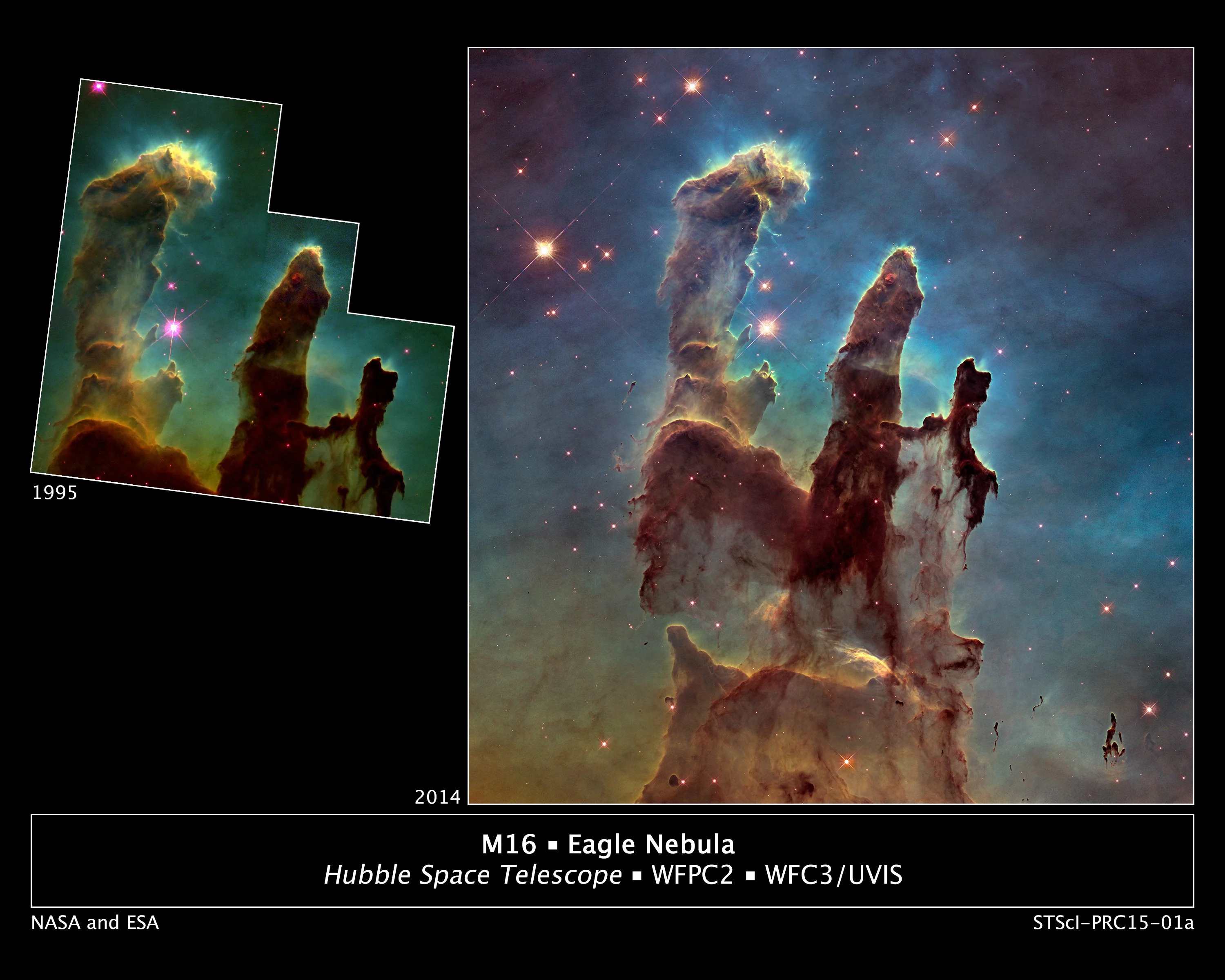
Few astronomical images have captured the public imagination as profoundly as the Pillars of Creation. Towering columns of cosmic gas and dust stretching across space, illuminated by the fierce radiation of nearby stars, have become one of humanity’s most recognizable portraits of the Universe. First unveiled in 1995 by the Hubble Space Telescope, the image transformed scientific observation into a cultural phenomenon and remains one of the most iconic space photographs ever taken.
But what makes the Pillars of Creation truly extraordinary is that the famous image represents only one way of seeing them.
The Universe does not reveal all of its secrets in visible light. Depending on the wavelength we observe, the Pillars can appear as dark silhouettes, glowing clouds, or transparent structures exposing hundreds of newborn stars hidden within cosmic dust. By studying this celestial masterpiece across the electromagnetic spectrum, astronomers are able to witness the life cycle of stars unfolding inside one of our galaxy’s most spectacular stellar nurseries.
The Pillars of Creation are not a single image—they are many different stories told by light.
What Are the Pillars of Creation?
The Pillars of Creation are enormous columns of interstellar gas and dust located within the Eagle Nebula (Messier 16), approximately 6,500 light-years from Earth.
These structures are composed primarily of:
- Cold molecular hydrogen
- Cosmic dust particles
- Ionized gases
- Dense regions where stars are actively forming
The largest pillar stretches several light-years across, making it vastly larger than our entire Solar System.
Although they appear solid in photographs, the pillars are incredibly diffuse. If placed inside Earth’s atmosphere, they would resemble an extremely thin vacuum by terrestrial standards.
The dramatic shapes we observe are the result of an ongoing battle between gravity and radiation. Nearby massive stars emit powerful ultraviolet radiation that gradually erodes the surrounding gas clouds. The denser regions resist this stellar wind, leaving behind towering structures that resemble cosmic mountains carved by light itself.
Why Light Determines What We See
Human vision is limited to a narrow portion of the electromagnetic spectrum known as visible light. Yet celestial objects emit radiation across many wavelengths.
Different wavelengths interact with matter differently:
| Wavelength | What It Reveals |
|---|---|
| Visible Light | Gas clouds and illuminated structures |
| Near Infrared | Hidden stars behind dust |
| Mid Infrared | Warm dust and star-forming regions |
| Ultraviolet | High-energy radiation from massive stars |
| X-rays | Extreme energetic processes |
| Radio Waves | Molecular gas and cold structures |
The Pillars of Creation serve as a perfect example of why astronomy depends on observing the Universe through multiple “cosmic lenses.”
Every wavelength reveals information that others cannot.
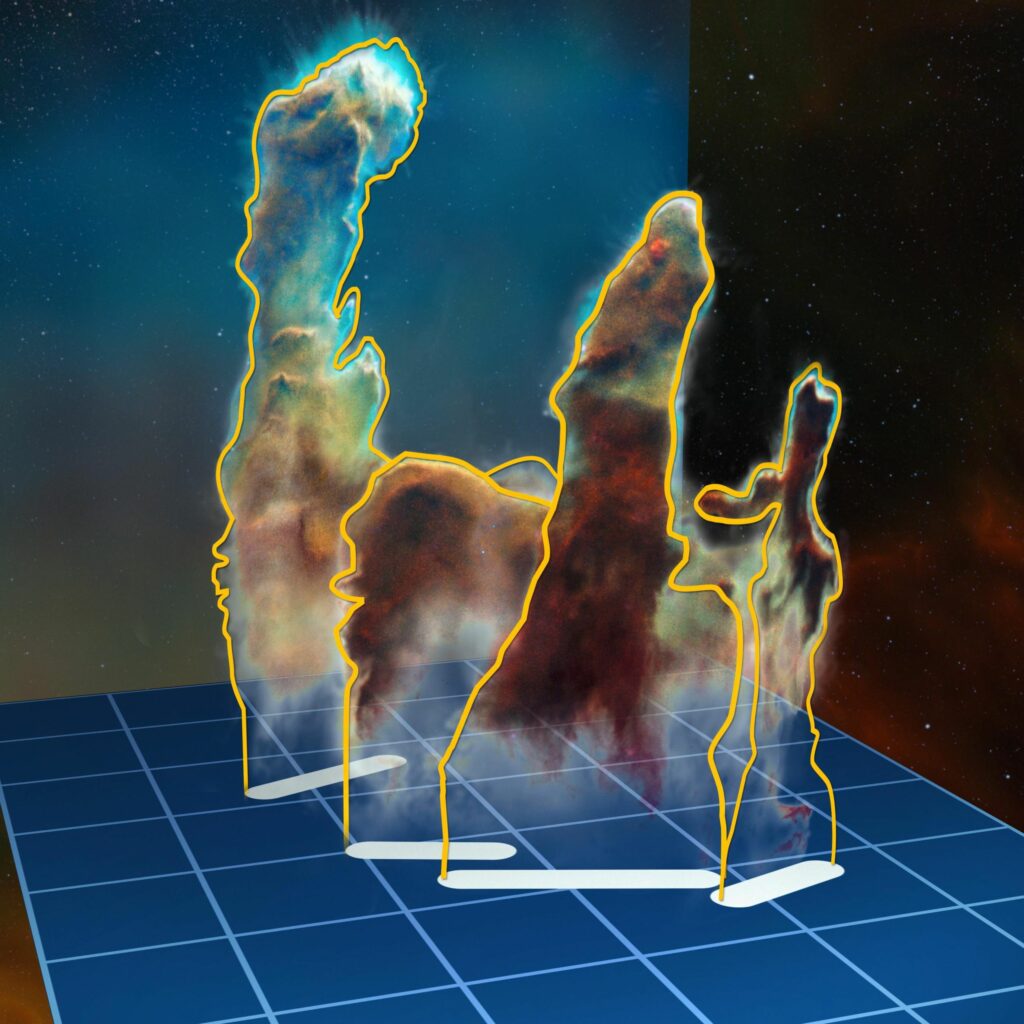
The Famous Hubble Image in Visible Light
When the Hubble Space Telescope captured the Pillars of Creation in 1995, the resulting image immediately became a scientific and cultural milestone.
Visible-light observations reveal:
- Towering dust columns
- Illuminated edges sculpted by radiation
- Dense pockets of star-forming material
- Dramatic contrasts between light and shadow
The iconic appearance comes from emission produced by several ionized gases within the nebula. Scientists assigned colors to specific chemical signatures to highlight different physical processes occurring inside the pillars.
Visible light allows us to appreciate their majestic structure, but it also conceals an important truth—the pillars are hiding something.
The darkest regions in the photograph are not empty space. They are so densely packed with dust that visible light cannot escape.
To truly understand what is happening inside these cosmic towers, astronomers needed to look beyond what human eyes can see.
Cosmic Dust: Nature’s Curtain
Cosmic dust plays a critical role in star formation.
Dust grains are incredibly small, often comparable in size to particles found in smoke. Despite their tiny dimensions, they are highly effective at blocking shorter wavelengths of light.
In visible-light observations, dust acts like a curtain that:
- Obscures newly forming stars
- Conceals dense molecular clouds
- Prevents astronomers from observing stellar interiors
- Creates the dramatic silhouettes seen in famous images
This limitation initially led scientists to believe that many regions within the pillars were nearly opaque.
The introduction of infrared astronomy dramatically changed our understanding.
Seeing Through the Dust with Infrared Light
Infrared radiation has longer wavelengths than visible light, allowing it to penetrate dust clouds far more effectively.
When astronomers observed the Pillars of Creation using infrared instruments, they discovered an entirely different cosmic landscape.
The dense columns that appeared dark and impenetrable in visible light suddenly became partially transparent.
Infrared observations revealed:
- Newly formed stars hidden within the pillars
- Stellar embryos still embedded in gas clouds
- Structures invisible in visible light
- The complex internal anatomy of star-forming regions
Instead of dark cosmic towers, astronomers began seeing a vibrant nursery filled with stellar activity.
This discovery transformed the Pillars from a beautiful photograph into a dynamic laboratory for studying star formation.
The James Webb Space Telescope’s Revolutionary View
In 2022, the James Webb Space Telescope released an infrared image of the Pillars of Creation that astonished scientists and the public alike.
Unlike Hubble’s visible-light portrait, Webb’s observations penetrated much of the surrounding dust and exposed countless stars hidden behind the famous structures.
The image revealed:
- Hundreds of previously invisible stars
- Jets of material ejected by young stellar objects
- Complex dust formations
- Detailed interactions between radiation and gas clouds
Perhaps most strikingly, the pillars themselves appeared less solid and more delicate than ever before.
What seemed like colossal cosmic monuments in visible light became translucent sculptures of gas and dust when observed in infrared wavelengths.
The comparison demonstrates one of the most important lessons in astronomy: the Universe changes dramatically depending on how we choose to observe it.
Star Formation Inside the Pillars
The Pillars of Creation are actively producing new stars.
Star formation begins when dense regions of molecular gas collapse under gravity. Over time, these collapsing clouds become:
- Protostars.
- Young stellar objects.
- Fully formed stars.
During the earliest stages, newly forming stars remain deeply embedded within dusty cocoons that prevent visible light from escaping.
Infrared observations are essential because they allow astronomers to study:
- Stellar birth
- Accretion disks
- Bipolar jets
- The interaction between young stars and their environments
Many of the brilliant points of light visible in modern infrared images represent stars that were once completely hidden from view.
In a sense, infrared astronomy allows us to witness cosmic births occurring thousands of light-years away.
The Pillars Are Slowly Disappearing
One of the most fascinating aspects of the Pillars of Creation is that they are temporary structures.
Massive stars located nearby emit intense ultraviolet radiation that gradually erodes the gas clouds.
This process is known as photoevaporation.
Radiation:
- Heats the surrounding gas
- Pushes material outward
- Carves intricate shapes into the pillars
- Slowly destroys the stellar nursery
Astronomers estimate that the pillars may survive for only a few hundred thousand more years—a brief moment in cosmic history.
Eventually, the magnificent structures immortalized by Hubble and Webb will vanish entirely.
The stars forming inside them, however, will remain as lasting evidence of their existence.
Why Multiple Wavelengths Matter
Modern astronomy depends on multiwavelength observations.
No single telescope can provide a complete picture of the Universe.
Visible-light observations reveal:
- Shape
- Ionized gases
- Surface structures
Infrared observations reveal:
- Hidden stars
- Dust composition
- Stellar nurseries
Radio observations reveal:
- Cold molecular clouds
- Gas distribution
X-ray observations reveal:
- High-energy stellar phenomena
By combining data from different parts of the electromagnetic spectrum, astronomers construct a more complete understanding of cosmic objects.
The Pillars of Creation have become one of the clearest demonstrations of this scientific approach.
They remind us that what we see is only one version of reality.
Why the Pillars Continue to Inspire
The enduring popularity of the Pillars of Creation lies not only in their beauty but also in what they represent.
They embody:
- The birth of stars
- The power of scientific discovery
- The evolution of astronomical technology
- Humanity’s ability to reveal the invisible Universe
Each new telescope offers another perspective on an object we thought we already understood.
The Pillars teach us an important lesson about science itself: discovery is rarely about finding entirely new things. Often, it is about learning to see familiar things in new ways.
Conclusion
The Pillars of Creation are far more than a single iconic photograph. They are a cosmic masterpiece revealed differently across the electromagnetic spectrum—a stellar nursery sculpted by radiation, hidden by dust, and illuminated through modern astronomy’s most advanced instruments.
Visible light introduced us to their breathtaking form. Infrared observations allowed us to peer through their dusty veils and witness stars being born. Together, these perspectives transform the Pillars into one of the most compelling scientific stories ever told through astronomical imagery.
Every wavelength offers a different chapter of that story. By learning to observe the Universe beyond the limits of human vision, we discover that even the most familiar cosmic icons still have secrets waiting to be revealed.
FAQ
What are the Pillars of Creation?
The Pillars of Creation are giant columns of gas and dust within the Eagle Nebula where new stars are actively forming.
Why do the Pillars look different in infrared images?
Infrared light can penetrate much of the cosmic dust, revealing stars and structures hidden in visible-light observations.
Who photographed the Pillars of Creation?
The famous 1995 image was captured by the Hubble Space Telescope, while the James Webb Space Telescope produced stunning infrared observations in 2022.
Are stars being born inside the Pillars?
Yes. The dense regions within the pillars contain protostars and young stellar objects undergoing the early stages of stellar formation.
Will the Pillars of Creation exist forever?
No. Intense radiation from nearby massive stars is slowly eroding the gas clouds. Astronomers expect the structures to disappear over cosmic timescales.